
How to Build a World Model
A Followup to Block’s “From Hierarchy to Intelligence”

On March 31, 2026, I read Block’s “From Hierarchy to Intelligence“ and started searching for how to build a “world model.” The week after that, a white paper from Fabio Ramos and Jônadas Techio, CEO and Product Leader of AXUR (now an Infoblox company), landed in my inbox. The May 26 version of this white paper opened like this:
Before Block published “From Hierarchy to Intelligence”, we were already building the layer they describe. Over seven weeks, more than twenty people across eight functions inside Axur built a new operational playbook from the ground up. None of them were engineers. Building infrastructure was not in any of their job descriptions. We did not plan for it to happen this way. We are publishing this because every knowledge company is about to face the question we faced, and most are about to answer it wrong.
How could that not catch your eye? I paced around my office reading it, trying to contain the excitement that I had found the answer. The very next week, we took the white paper and implemented it at The Atticus Project. Each of my two colleagues built their own GitHub instance. Now we have CLawEO running daily: a shared agentic operating system that pushes a log of important actions each day, and answers team questions. The next phase of CLawEO is to help us make decisions for a nonprofit where I have my hands full as the CLO of Infoblox, and the staff at The Atticus Project are fresh graduates.
Block’s Blog and Axur’s White Paper
In their March blog, Jack Dorsey explained that in order to flatten an organization and make it more efficient, an organization needs a world model of its operations. But the blog stopped short of telling me how.
Where Dorsey says you need a world model, Fabio and Jônadas show what that looks like in practice. “Restructuring Knowledge Work for Human-Agent Teams: a Manifesto” describes what their team built over seven weeks, with twenty people across eight functions, none of them engineers. The six principles in the manifesto include:
Knowledge lives in Markdown files in Git. Everything the company knows should live in plain text, version-controlled and readable by every major AI tool. Everyone should be in Git. Lawyers, marketers, finance, customer success, executive assistants. Everyone whose work product is durable enough to be worth keeping should be in a Git repository by next year.
Progressive disclosure. No agent loads the entire knowledge base to answer one question. A thin index at the top points to topic-specific files, and the agent reads only what the current task requires. The knowledge base can scale to thousands of files without slowing anything down.
Shared truth, personal workspace. One source of truth that everyone reads from and contributes to, plus a personal layer each contributor manages on their own. This prevents the two failure modes of every knowledge system: the wiki nobody updates because contributing is too heavy, and the wiki nobody trusts because anyone can write anything.
Tool agnosticism. The knowledge layer does not depend on any specific AI tool. Git is the transport, Markdown is the format, and any LLM that can read files can operate on it. Switch tools and the layer is unchanged.
Status markers as behavioral gates. Documents carry machine-readable signals about their own reliability: [TBD], [DRAFT], [NEEDS-UPDATE]. Constraints travel with the knowledge, not with the chat session. The document becomes a participant in the workflow.
Skills as reusable intent. Agent workflows encoded as versioned Markdown files, not one-off prompts. A skill defines a workflow, its trigger, its tools, and its expected output. Once encoded, any function can compose against it.
I read the full paper and then went back to the beginning and read it again.
What We Built at The Atticus Project
The next week, we started building. We are a legal AI nonprofit whose core work is creating benchmark datasets and training materials on AI for legal professionals. None of us had set up an agentic operating system before. Within two weeks, each of my colleagues had their own GitHub instance. I just copied one of theirs. Within a month, we had CLawEO running daily.
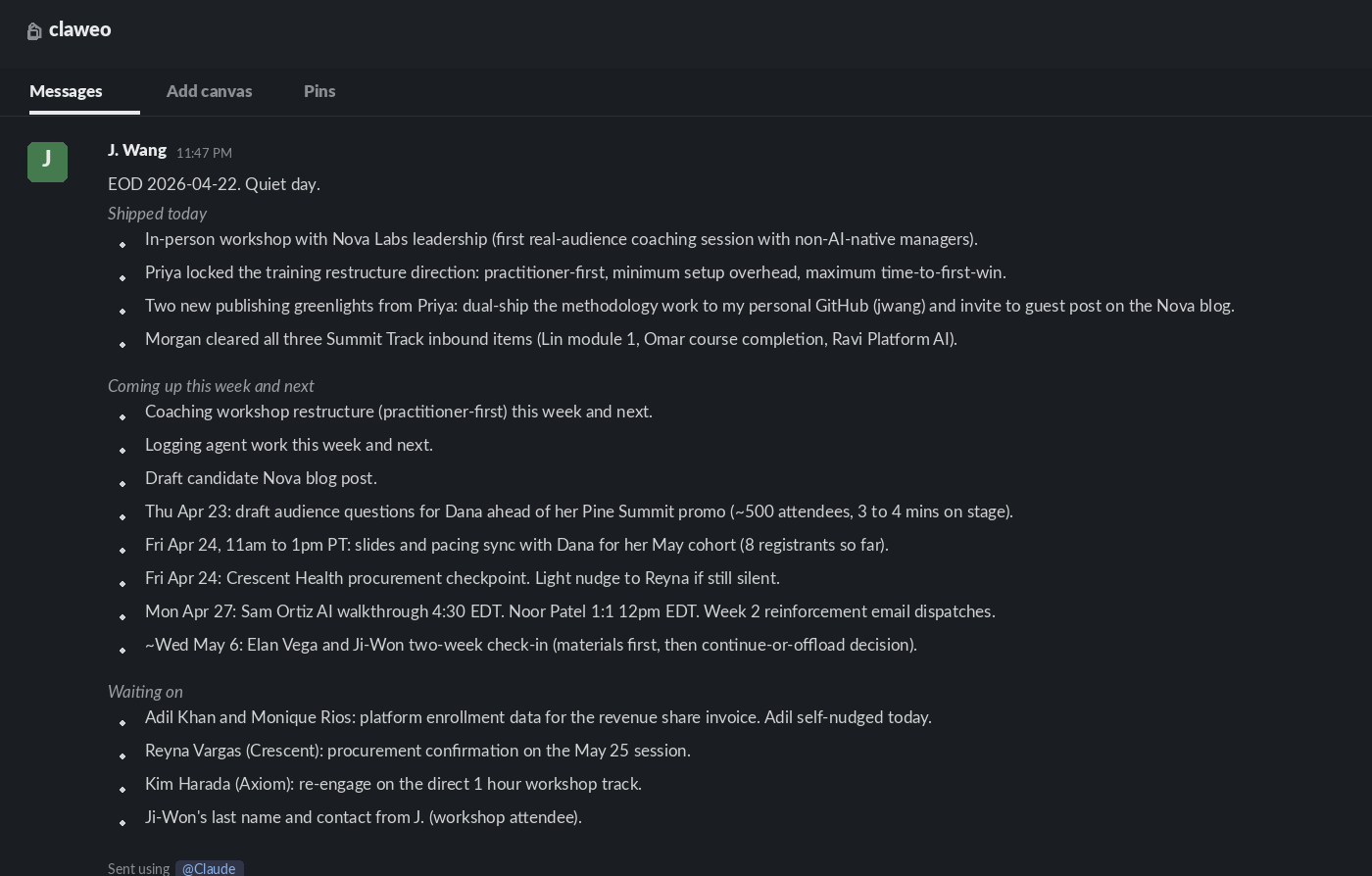
The name of CLawEO is a play on CLO and CEO and law: The Atticus Project’s CEO-level agentic operating system, living in a shared repository of Markdown files, including the organization’s benchmark datasets, academic paper, training videos and scripts, presentations, blogs, contacts. A rolling daily-update audit trail and a team Slack channel are built on top for ease of consumption.
Every day we receive via Slack a list of actions automatically pushed from the previous day. See screenshot below for a sample with identifying information replaced with fake names and entities. We can query CLawEO for basic questions. It is not the full intelligent world model that we hoped for yet, but what we have is already changing how we work. No one needs to wait for a call or an answer from me because they can ask ClawEO. Unlike me, CLawEO is always present, always readable, and very persistent.
This week, we put our “world model” to the ultimate organizational test: one of our team members is leaving. Normally, this would have triggered a scramble to schedule transition meetings, hunt down missing documents, and capture “tribal knowledge”. Instead, the team spent the time on a relaxed send-off with lots of laughs and good wishes, while CLawEO is in the background collecting knowledge institutionalized daily in versioned Markdown files.
Benefit of “World Model” to the Next Generation
Entry-level employees will no longer have the luxury of being trained the old-fashioned way over many long years. What they need instead is to build their unique skills on top of what is already institutionalized from the tribal knowledge of their senior peers. The world model makes that possible. The benchmarks, the presentations, blogs, the decisions, the reasoning: all of it lives in versioned Markdown that a new colleague can read, query, and build on from day one. At The Atticus Project, we proved it is possible. My entry-level staff members, freed from the burden of having to learn from scratch, could build on top of what Atticus already knew: architecting the CLawEO structure, and thinking creatively about how to run our business in ways I would not have thought to ask of them. They are not repeating the past. They are forging ahead to the future.
Thank You, Fabio & Jônadas
I am so excited to see Fabio and Jônadas’s full manifesto published earlier this week, alongside with the GitHub repository that contained a working starter kit. You can download and use right away: An Agentic Operating System: Seven Weeks of Practice, agentic-os starter kit.
On behalf of those who are looking for an answer to building a “world model”, thank you, Fabio and Jônadas!
—---------
For more practical tips on AI governance and innovation, check out GenAI for the Legal Profession: Power User Edition, AI Strategy for Legal Leaders, Atticus AI Habits Workshop and my Fairly AI blogs. Interested in a 1:1 Claude Cowork coaching session? Contact us at aicoach@atticusprojectai.org.